


Most of West Virginia’s November ballot was settled in May. Republicans will win the overwhelming majority of legislative seats, Shelley Moore Capito will win her third Senate term, and Carol Miller and Riley Moore will hold their congressional seats without serious challenge.
But several races on the November 3 ballot are genuinely interesting, for reasons that go beyond partisan horse race math. Here is the WASP’s guide to what we think actually matters between now and election day.
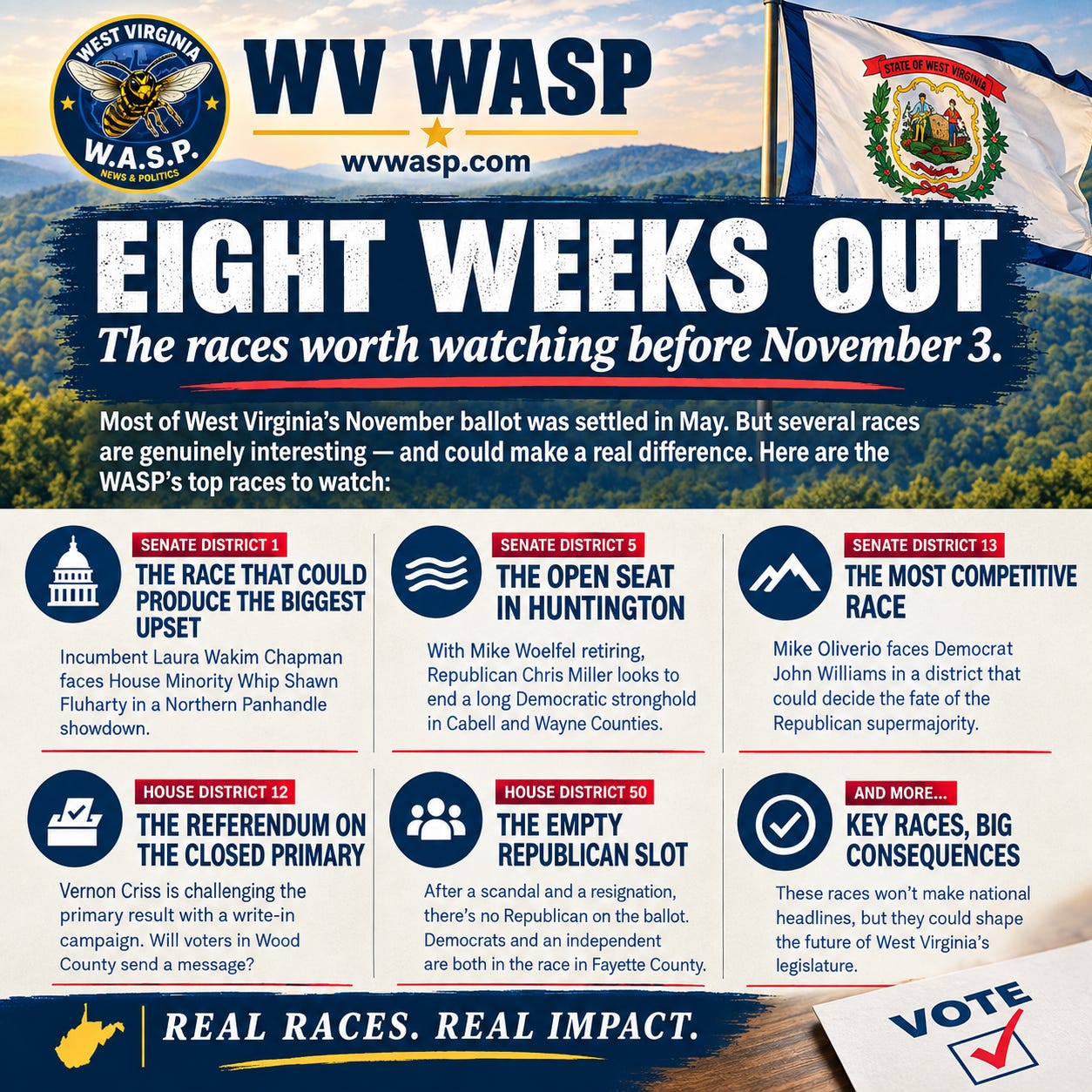
Senate District 1: The Race That Could Produce the Biggest Upset
The Northern Panhandle race between incumbent Laura Wakim Chapman and Delegate Shawn Fluharty deserves more attention than it is getting.
Chapman won her Republican primary over former Eagle Manufacturing President Joe Eddy by 59% to 41%, a margin that suggests some vulnerability heading into November. She now faces Fluharty, the House Minority Whip, in the general election.


Fluharty is not a typical West Virginia Democrat. He is a 12-year Delegate with high name recognition across Hancock, Brooke, Ohio, and Marshall Counties, an aggressive campaigner, and a politician who has spent his career building real relationships in a region that still has genuine Democratic infrastructure. The district’s partisan index is R+39.2, which is comfortable territory on paper. Fluharty would not be running if he thought those numbers were insurmountable.
Chapman is on the “Team Randy” fundraiser list. Senate President Randy Smith has skin in this race. A Fluharty win would cost Smith a reliable ally and hand Democrats their first Senate pickup in years.
Senate District 5: The Open Seat in Huntington
Mike Woelfel served as Senate Minority Leader and held this Cabell and Wayne County seat for twelve years as one of only two remaining Senate Democrats. He is retiring. That creates a genuine open seat race in a district with an interesting political split: it voted D+12 in the 2022 Senate race while going R+24.7 in the presidential election. Classic crossover territory, and now without an incumbent to hold it.
The Republican nominee is Chris Miller, an auto dealer, son of U.S. Rep. Carol Miller, and the man who ran for governor in 2024 and lost to Morrisey in the primary. Miller is a known quantity in the Huntington area with name recognition and resources. He is well-liked by the electorate and is not a bomb thrower.
Woelfel’s retirement likely ends the last Democratic Senate stronghold in southern West Virginia. Whether Miller can consolidate that shift in November, or whether a credible Democrat can hold on in Huntington one more cycle, is worth watching. We think Miller will roll and a long time Democratic stronghold will cease to exist.
Senate District 13: The Most Competitive Race
Mike Oliverio is running another genuinely competitive Republican Senate race in November. The 13th District, covering Marion and Monongalia Counties, has a partisan index of R+5.6, meaning it leans Republican but is far from safe. Democrat John Williams, a Delegate, is his opponent.


Smith left Oliverio off the “Team Randy” fundraiser list. The implicit message: Oliverio is too moderate for the coalition Smith is building and he has to survive November on his own. Oliverio is a former Democrat, a financial planner, a veteran, and a politician who has spent years threading the needle in a district that has real Democratic infrastructure in Morgantown. He has done it before. Whether he can do it again in a midterm environment where national headwinds are uncertain is one of the most competitive legislative races in the state.
A Williams win here would reduce the Republican Senate supermajority by one. It would also hand Randy Smith an awkward outcome: the senator he declined to fund survived, or the senator he declined to fund lost. Either result is interesting.
House District 12, Wood County: The Referendum on the Closed Primary
The WASP has covered this race some and we plan to do a deeper dive soon. Vernon Criss, the former House Finance Chairman who lost his May primary to 23-year-old Charles Hartzog by 688 to 423 votes, filed as a write-in candidate. He is asking the 96% of District 12 voters who did not participate in the closed primary to weigh in on the result. We did a series on the open/closed primary.
Hartzog holds the Republican nomination. Criss has no ballot line. Write-in campaigns in legislative races almost never succeed, but this one could cut against the grain. The mechanical challenge of getting voters to write a name correctly in the booth is substantial.
But the political argument Criss is making is real and resonant. Hartzog received fewer primary votes than Criss drew running unopposed four years ago. Governor Morrisey personally campaigned against Criss, and Americans for Prosperity spent close to $100,000 against him. The November electorate in Wood County will be several times larger than the May primary turnout.
District 12 is, as the WASP has previously written, the answer key to the closed primary debate. If Criss wins, the 688 votes that produced Hartzog’s nomination will have been repudiated by the broader district. If Hartzog wins, the primary result stands.
House District 50, Fayette County: The Empty Republican Slot
Elliott Pritt was arrested on federal child enticement charges in July, resigned his House seat, and filed a notarized withdrawal from the November ballot in August from a Kentucky detention facility. Because of a provision deleted from HB 4350 by Senator Jack David Woodrum’s Senate committee in 2024, the Fayette County Republican Executive Committee had no legal path to replace him on the ballot.
Democrat Mathew Anderson, a special education teacher, and independent Tom Louisos, a former Fayette County Commission president, are the candidates on the ballot. No Republican. In a district Republicans had held, this is a seat now genuinely in play through no fault of the local party.
Whether Louisos, a candidate with name recognition, can consolidate enough of the conservative vote to make it competitive is the variable we don’t have a clean answer to.
The WASP covered this story in depth in “The Law That Locked the Door.” The November result will be its epilogue.
House District 76: Marion County’s Crossover Race
Rick Garcia is one of only nine Democratic members of the House of Delegates, and he is defending his seat in Marion County against Republican Jon Dodds, the same candidate Garcia beat in 2024. Garcia won that race with approximately 51% of the vote in a district where Donald Trump ran significantly stronger in the presidential race. That crossover dynamic, a district that votes Democratic for the House but Republican for president, is exactly the kind of seat that can flip in a midterm environment. But we are keeping in mind a volatile midterm for Republicans considering the national political dynamics.
Garcia has the name recognition advantage as the incumbent. Dodds has the partisan environment on his side. Watch Marion County.
House District 82: The Morgantown Seat That Could Swing
David McCormick won House District 82 in Monongalia County in 2024 with approximately 54%, in a district that includes the Cheat Lake area and parts of Morgantown’s suburban fringe. The Morgantown orbit is one of the few places in West Virginia where Democrats still have genuine infrastructure, a university town with a younger electorate than the state average.
McCormick is an Assistant Majority Leader, which gives him resources and visibility. He faces a Democratic challenger in November in a district that has historically been more competitive than the rest of the state’s House seats. Not a likely flip, but worth watching if you are tracking whether Democrats can chip away at the Republican House supermajority.
The Senate Civil War’s First Report Card
Seven Republican incumbents were left off Randy Smith’s Team Randy fundraiser list, as the WASP detailed last week. Most of them will almost certainly win their November races.
But the details of those races matters for what happens in January. A senator who wins with 70% of the vote in a safe district returns to Charleston with different leverage with Team Randy than one who scraped through with 51%. Smith will be watching those margins. So will Eric Tarr, Tom Takubo, Vince Deeds, and everyone else making calculations about the gavel fight.
The most interesting number to track on Senate election night is not who wins. It is how the seven off-list senators perform compared to the fourteen on-list senators. That comparison is probably not one other outlets will be making on election night. The WASP will.
Capito, Miller, Moore: The Foregone Conclusions
Shelley Moore Capito faces Democrat Rachel Fetty Anderson (a former Morgantown city councilmember), and Constitution Party Chairman, S. Marshall Wilson. Capito will win by a wide margin. The race is not competitive.
Carol Miller faces Democrat Vince George and Constitution Party candidate Belinda Fox-Spencer in the 1st Congressional District. Riley Moore faces Democrat Ace Parsi in the 2nd. Neither race is competitive.
The statewide races will be decided before most West Virginians finish their dinner on election night. The action is downballot.
What to Watch on November 3
The WASP will be covering election night with a focus on the races above. The District 1 result comes from the Northern Panhandle. The District 5 results come from the Huntington area. The Oliverio result comes from the north-central region. The Criss write-in result comes from Wood County. The District 50 result comes from Fayette County. The Senate margin comparisons require the full set of results.
The foregone conclusions will be called early. The interesting results come later.
Eight weeks. A lot can still happen. 🐝
The WV WASP is a West Virginia political news, humor, and commentary outlet. wvwasp.com | @wvwasp on X.